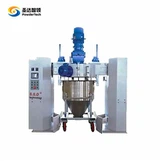
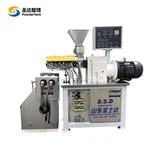
The screw length-to-diameter ratio (L/D ratio) is a fundamental parameter in the design and operation of a powder coating extruder. As a reputable Powder Coating Extruder supplier, we've witnessed firsthand how this ratio can significantly impact the extrusion process, product quality, and overall performance in powder coating production. In this blog, we'll explore the influence of the screw L/D ratio on powder coating extrusion and shed light on its implications for manufacturers.
Understanding the Screw Length-to-Diameter Ratio
The L/D ratio of a screw in an extruder is defined as the ratio of the effective length of the screw to its outer diameter. For example, if a screw has an effective length of 1000 mm and a diameter of 200 mm, its L/D ratio is 5:1. This ratio plays a crucial role in determining the residence time of the powder coating material within the barrel, the degree of mixing, shear forces applied, and the heat transfer efficiency.
Influence on Mixing and Homogeneity
One of the primary functions of a powder coating extruder is to mix various raw materials thoroughly to achieve a homogeneous product. The L/D ratio directly affects the mixing efficiency. A higher L/D ratio provides a longer flow path for the material, allowing more time for the powder components to blend. As the powder coating material travels along the screw, the flights on the screw continuously knead and distribute the different ingredients.
With a larger L/D ratio, the material experiences more cycles of compression, relaxation, and re - orientation. This enhances the dispersion of pigments, additives, and binders, resulting in a powder coating with more uniform color, texture, and properties. For instance, in a Double Screw Powder Coating Extruder with a high L/D ratio, the twin screws work in tandem to intensify the mixing action. The longer length of the screws allows for multiple mixing zones, which break down agglomerates and ensure that every particle of the powder is coated and uniformly distributed.
Impact on Shear Force and Melting
Shear force is another critical factor in powder coating extrusion. It is responsible for breaking down the powder particles, melting the resin components, and dispersing fillers. The L/D ratio can adjust the shear force applied to the material. A longer screw can generate higher shear forces by providing more surface area for the material to interact with the screw flights and the barrel wall.
When the L/D ratio is increased, the material is subjected to a more extended period of shear stress. This is beneficial for melting the polymer resins in the powder coating formulation. The frictional heat generated by the shear action helps to reduce the melting point of the resins, enabling a more efficient melting process. However, excessive shear force can also lead to thermal degradation of the polymers if not carefully controlled.


For example, in a High Torque Twin Screw Extruder, a well - designed L/D ratio allows for precise control of shear. The high - torque capacity of the extruder, combined with an appropriate L/D ratio, can ensure that the powder coating materials are melted evenly without overheating.
Effect on Residence Time and Heat Transfer
Residence time refers to the amount of time the powder coating material spends inside the extruder barrel. A higher L/D ratio generally means a longer residence time. This extended time is advantageous for heat transfer. As the material moves along the screw, it comes into contact with the heated barrel, and heat is transferred from the barrel wall to the powder.
Optimal heat transfer is essential for melting the powder and achieving the desired viscosity for extrusion. A longer L/D ratio allows for more heat transfer opportunities, enabling better control of the melting process. The materials are heated more gradually, reducing the risk of local overheating and ensuring a more consistent melting of all components.
In a Powder Coating Double Screw Extruder Machine, the design of the screw and the barrel, along with an appropriate L/D ratio, promotes efficient heat transfer. The double - screw configuration increases the surface area of the material in contact with the heated barrel, enhancing the overall heat transfer coefficient.
Influence on Extrusion Output and throughput
While a higher L/D ratio can improve mixing, shear, and heat transfer, it can also have a negative impact on the extrusion output and throughput. A long screw means that the material has to travel a greater distance, which can slow down the overall flow rate. This is because the resistance to flow increases as the length of the screw increases.
Manufacturers need to find a balance between the desired product quality and the required production rate. In some cases, a moderate L/D ratio may be sufficient to achieve acceptable product quality while maintaining a high - throughput extrusion process. For example, if a manufacturer needs to produce large quantities of powder coating with relatively simple formulations, a lower to moderate L/D ratio may be selected to maximize the output without sacrificing too much on product quality.
Considerations for Selecting the L/D Ratio
When choosing the appropriate L/D ratio for a powder coating extruder, several factors should be taken into account. These include the complexity of the powder coating formulation, the desired product quality, production capacity requirements, and the properties of the raw materials.
- Formulation Complexity: If the powder coating formulation contains a wide variety of additives, pigments, and fillers, a higher L/D ratio is usually preferred to ensure thorough mixing. Conversely, a simpler formulation may not require a very high L/D ratio.
- Product Quality Requirements: For applications where high - quality, defect - free powder coatings are necessary, such as in automotive or high - end architectural applications, a larger L/D ratio can be beneficial. This helps to achieve better homogeneity, color consistency, and a smooth finish.
- Production Capacity: Manufacturers with high - volume production targets need to balance the desire for a high - quality product with the need for high throughput. A judicious selection of the L/D ratio can help optimize both aspects.
Conclusion
The screw length - to - diameter ratio is a vital parameter in powder coating extrusion. It has a far - reaching influence on the mixing, shear, heat transfer, residence time, and throughput of the extrusion process. As a Powder Coating Extruder supplier, we understand the importance of choosing the right L/D ratio for different production requirements.
Our range of Double Screw Powder Coating Extruder, High Torque Twin Screw Extruder, and Powder Coating Double Screw Extruder Machine can be customized with different L/D ratios to meet the specific needs of our customers. Whether you are looking to improve product quality, increase production efficiency, or develop new powder coating formulations, our team of experts is here to assist you in making the right choice.
If you are interested in our powder coating extruders or would like to discuss your specific requirements, please feel free to reach out to us. We are ready to engage in a productive procurement discussion to help you achieve your powder coating production goals.
References
- "Extrusion of Polymers: Theory and Practice" by George Gogos and P. J. Gramann
- "Handbook of Powder Coatings" by Tim Smith